
A Nostalgic Look at How Our Favorite Digital Worlds Grew Up
A Nostalgic Look at How Our Favorite Digital Worlds Grew Up
There’s something magical about an open-world game. You boot it up, drop into a vast scene, and suddenly every mountain peak, abandoned building, and suspiciously quiet forest looks like an invitation to wander. Today, we take that freedom for granted. We expect worlds dense with quests, characters, physics systems, day-and-night cycles, and maybe even a chill medieval guard to tell you stories about the time he took an arrow to the knee.
But open-world games didn’t start as the massive, living ecosystems we know today. They began as modest, pixelated experiments and rough sketches of what designers wished they could bring to life. And the evolution from those early digital sandboxes to the sprawling worlds of today is a story of technology, ambition, chaos, and yes…way too many side quests.
So buckle up—let’s take a nostalgic stroll through where open-world games came from, where they are now, and how the genre transformed into the behemoth shaping modern gaming.
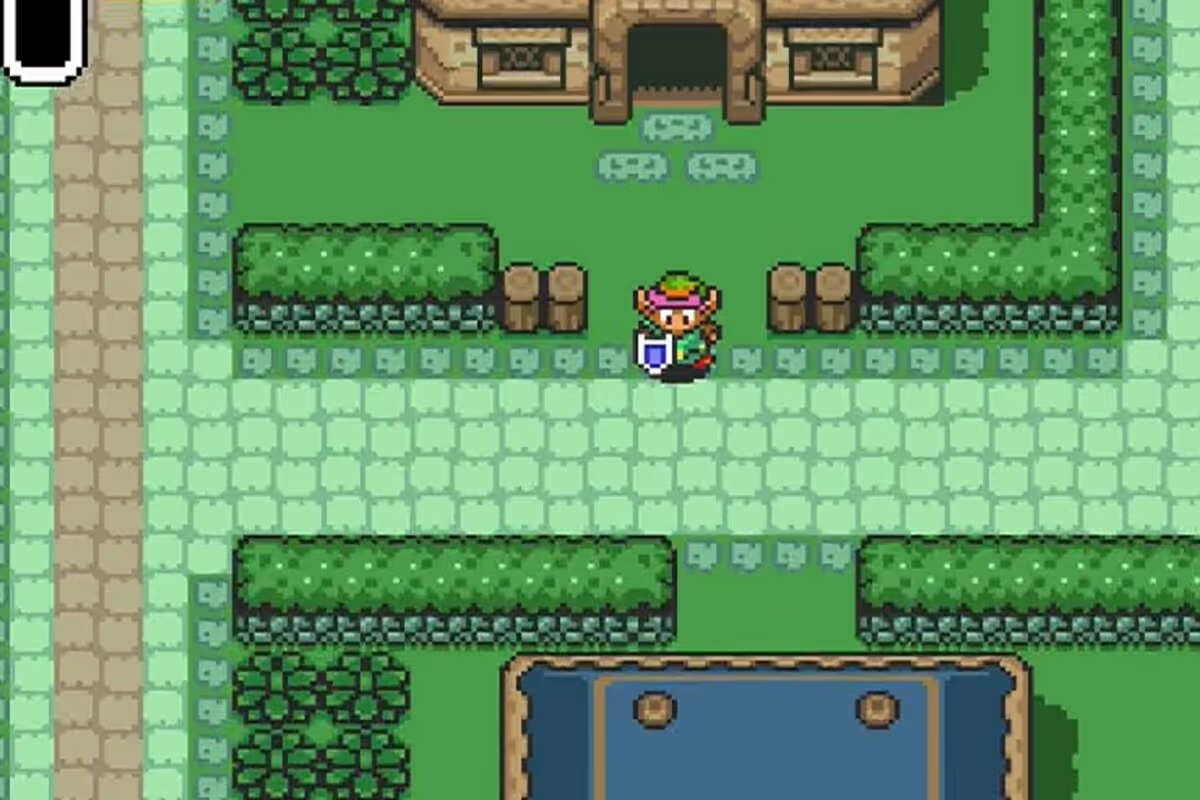
In the early days, open-world games were less about simulating life and more about creating the feeling of expansiveness. Hardware limitations forced developers to prioritize simplicity—the world could be large, but not dynamic. You could wander, but only within the constraints carefully plotted around memory budgets measured in kilobytes. The earliest open-world experiences relied heavily on repetition and abstraction—tile-based maps, looping environments, very limited interactions—yet players still saw the possibility where technology fell short.
Early open-world games were charming, but let’s be honest—they were more “open” in theory than in practice with the invisible walls everywhere. NPCs who said one sentence and then ceased to exist. Quests that had about as much depth as a parking lot puddle. But they were ambitious and they were the spark.
As technology improved, the definition of an open world expanded. The conversation shifted from “how large can a map be?” to “how alive can it feel?” Suddenly, developers weren’t just carving out space—they were filling it. Towns became more than static backdrops, NPCs became more than stationary quest-givers, and player choice started influencing outcomes in meaningful ways.
This era marked the rise of agency-driven design. Worlds grew more reactive and player’s decisions and behaviors began shaping how NPCs responded, how quests unfolded, and how the environment evolved. Exploration no longer meant walking from point A to B,it meant stumbling into dynamic encounters, branching missions, hidden storylines, and environments with their own logic.
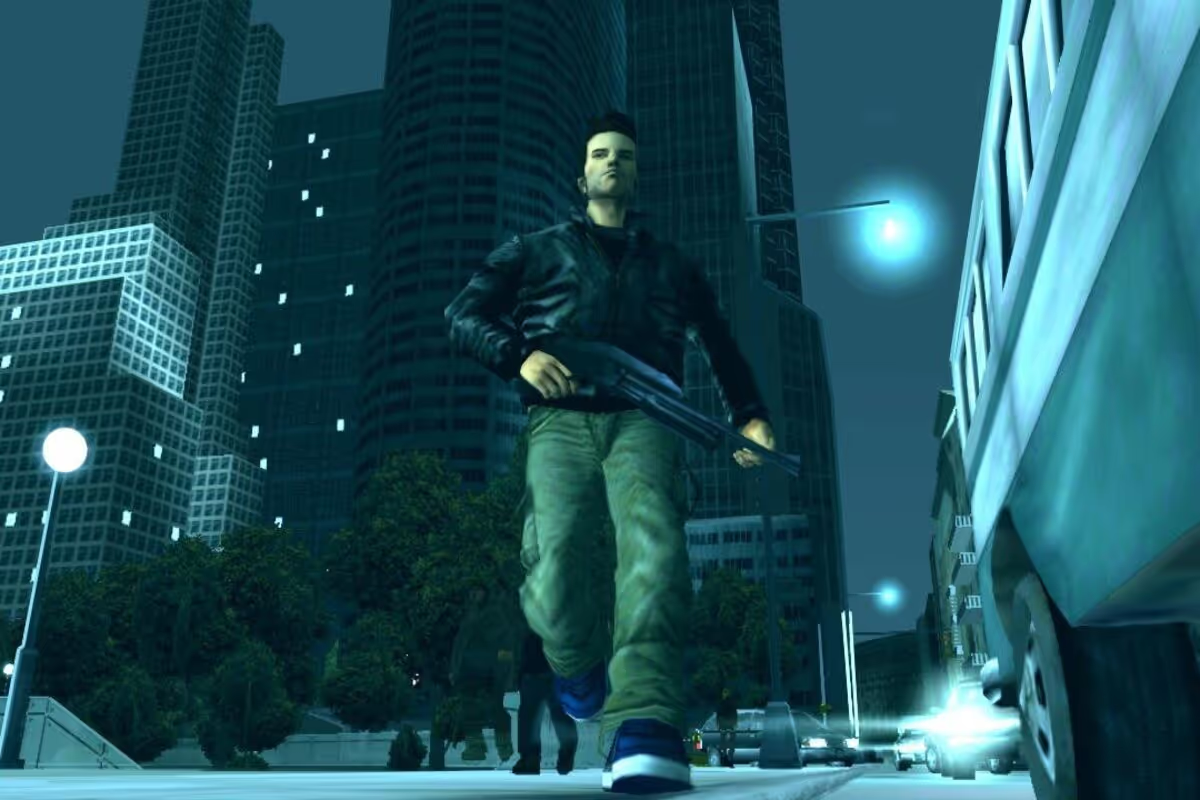
Enter the titan: Grand Theft Auto III (2001). This game didn’t just move the needle, it snapped the whole meter in half. Liberty City wasn’t just a map, it was a playground for many—one that was drenched in chaos, humor, crime, and possibility. You could drive anything, punch anyone, or ignore the main story entirely to see how many lampposts your car could take out before exploding. It was freedom.
Following GTA’s success, the decade exploded with innovation:
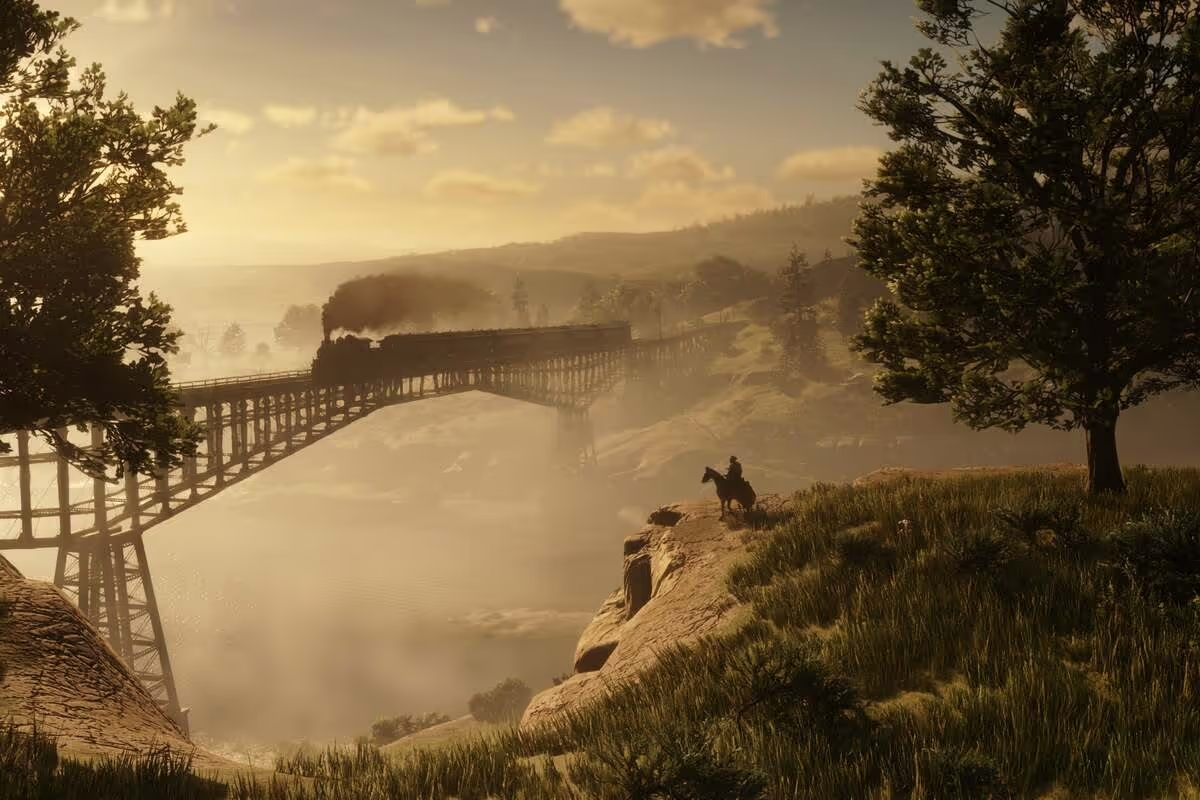
If you’ve ever opened a modern AAA open-world game, zoomed out on the map, and felt genuinely baffled that such a thing can exist within the confines of your storage capacities of your console, you are not alone, they are truly something to behold. Contemporary open-world games operate on a scale that would’ve been impossible a generation ago. But size alone is no longer the headline. Today, the defining element of an open world is its systems. We’re talking about physics systems that dictate how objects react. Narrative systems that allow flexible and overlapping progression paths, and AI systems that govern NPCs schedules and behaviors.
The equation of today’s open-world games is rather simple, actually. Immersion is now the main focus in terms of creating a well-crafted open-world game. The world should almost feel like a living organism in-and-of itself, with or without their input. This systemic design has unlocked what players often describe as “emergent gameplay,” the moments when unscripted encounters feel more memorable than anything crafted by the writers.
This era gave us some of the greatest open-world masterpieces ever created:
A world so detailed you can literally hear a difference in the sound that various footwear makes, observe how rope and clothes hanging on a clothes line move with the proper physics, or watch how wildlife follows freakishly realistic patterns. Rockstar’s open world stands as one of the most meticulously crafted environments in modern gaming. This is what we mean when we speak of immersion. Nearly every system—weather, wildlife, NPC routines, sound design, physics—feeds into an ecosystem that feels authentically alive!
FromSoftware’s approach to open-world design is almost the opposite of the traditional formula. There’s no minimap clutter, no quest lists, no breadcrumb trail leading you to your next objective. Instead, the world itself—the landmarks, the silhouettes on the horizon seem to be what guides your curiosity. Exploration isn’t a side activity…it is the game. Enemies aren’t just scattered around as filler, they are placed with the utmost intention and somehow seem to steer your path. Elden Ring transforms “open world” into a model of trust: the game trusts you to figure things out, and that trust becomes one of its greatest strengths.
Night City is a dense, vertical, multi-layered sandbox built around the chaos and contradictions of a futuristic metropolis. Beyond the neon lights and sick holographic ads, the city is structured like a hierarchy of overlapping cultures, classes and criminal factions. This one is incredibly unique and manages to deliver a world that feels busy, alive, and relentlessly moving.
The ultimate “playground of physics” approach. If you can imagine it, you can probably fuse it, launch it, or accidentally blow yourself up with it. Nintendo didn’t take the hyper-realistic route, instead, they put an emphasis on freedom through possibility. Surfaces conduct electricity, objects carry momentum, materials fuse together in inventive ways, and anything that isn’t nailed down can usually be moved, combined, or rebuilt. Tears of Kingdom sets itself apart by rewarding players not only for following a predetermined path, but for thinking creatively.
Modern open worlds focus less on checklist design and more situations that unfold naturally based on the player’s choices. Developers are finally embracing the idea that players create the best stories when they’re simply given tools and freedom, rather than rigid objectives.
Old open worlds were mostly large, empty spaces filled with a few things scattered around. Modern games fill their maps with layered environments, secrets, and reactive systems. It’s no longer about how big the map is, but how much meaning is packed into every area.
Early open world said, “Go wherever.” Modern ones say, “Go wherever—and here’s something interesting when you get there.” You’re encouraged to wander because the world is designed to respond.
Graphics improved dramatically, but immersion now goes beyond visuals. Modern games use sound, physics, weather, and unbelievable NPC behavior to make worlds feel lived in. It’s not just about looking real—it’s about feeling real.
Older titles gave you simple tools, like a basic weapon or vehicle. Now, games combine tools with all kinds of other connected systems. For example, you have things such as crafting, physics, more movement mechanics, survival elements—all of which help to deepen the experience. Every mechanism interacts with others to create more possibilities.
Story lines used to follow a straightforward path from start to finish. Today, open worlds often let players shape their own narrative through choices, exploration, and unexpected encounters. The world gives you space to create moments that feel uniquely yours.
If the past decade has been defined by scales and systems, the next stage of open-world design will likely focus on personalization and adaptive storytelling. Advances in AI, and simulation technology are moving the genre toward worlds that adjust even more dynamically to the player—not just in small, reactive ways, but in sweeping structural ones.
Future open worlds may even tailor events, ecosystems, and narrative arcs around how someone actually plays, rather than funneling them into predefined branches. The goal won’t be to make bigger maps, it will be to create maps that feel uniquely yours.
Despite all the advancements, the core philosophy of open-world games hasn't changed much. They’re still about stepping into a space that feels bigger than yourself, where movement becomes meaning and curiosity becomes story. What changed is the industry’s ability to fulfill that promise on a level that once sounded impossible.


